At first glance, biobanks and information technology may seem to belong to two completely different worlds. One deals with test tubes, freezers, scientific research, and laboratory equipment, while the other focuses on servers, software, cables, and data. In reality, however, modern biobanking could not exist without IT. The more samples researchers collect, the more these two worlds become interconnected.
Software at every step
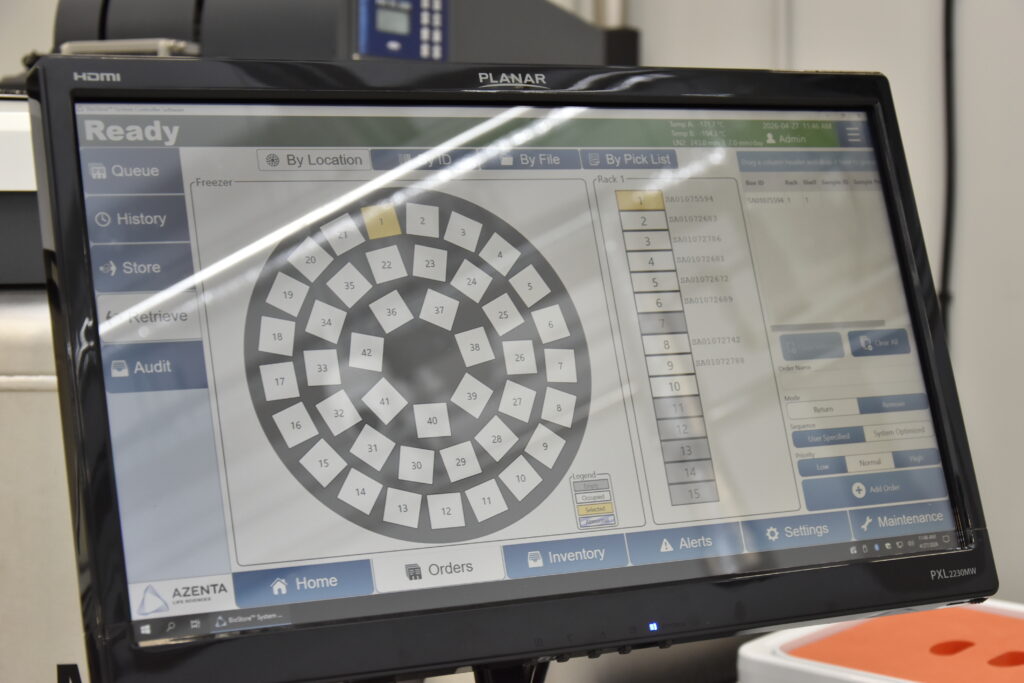
A modern biobank is filled with software systems. Robotic freezers operate using their own control systems, monitoring platforms oversee their performance, and even automated laboratory pipetting devices rely on specialized software. The central “master” coordinating all these systems is the BIMS (Biobank Information Management System).
BIMS tracks every stage of a sample’s lifecycle, from collection, transport, processing, and storage to the moment it is released for research and to whom. It communicates with freezers and laboratory equipment, verifies whether samples were processed and archived correctly, and ensures traceability.
Without BIMS, managing thousands or millions of samples would become chaotic, much like a hospital trying to function without a patient management system.
Always the same cold
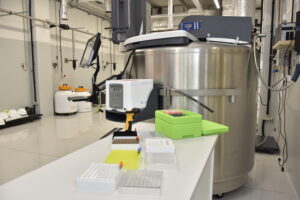
Modern cryogenic freezers (storing samples at temperatures such as -20°C, -80°C, or -190°C) are highly sophisticated technologies equipped with networks of sensors that continuously monitor temperature, humidity, and other environmental conditions.
IT systems ensure that these devices send data to central monitoring platforms. For example, if the temperature inside a freezer rises by even one degree, the system immediately sends alerts to the responsible staff so the issue can be resolved. This automated supervision can save thousands of samples from irreversible damage.
When scanners keep everything organized
Manually writing information on sample labels may sound reliable, but in practice it would quickly lead to confusion. Human errors can occur – handwriting may become unreadable, labels may be damaged, or information may be misinterpreted, especially across different languages.
For this reason, samples are identified using machine-readable codes such as barcodes, QR codes, or RFID chips. Coding ensures that sample identification remains fast, accurate, and readable both by humans and machines.
With a single scanner beep, the BIMS can instantly display the complete profile of a selected sample.
Data for humans, machines, and AI
A sample record requires much more than a simple code and collection date. Information such as sex, age, diagnosis, collection conditions, sample type, processing method, and many other metadata fields must often be included.
If this information were entered freely by individuals using different languages, abbreviations, or naming conventions, interoperability would become impossible. This is where IT systems and standardized terminologies become essential.
Data must be stored in a way that is independent of language, country, or personal abbreviations. In practice, when a physician enters information indicating that a patient has vocal cord cancer, the system automatically suggests an internationally standardized diagnosis term. For example: “C32.0 Malignant neoplasm of glottis.” A specialist abroad may view the diagnosis in their own language, while the machine processes only the standardized code “C32.0”.
Machine readability is essential because modern biobanks generate data volumes far beyond what humans can manually analyse. Statistics, pattern recognition, and sample matching are increasingly performed by algorithms and artificial intelligence (AI).
If a new study contains hundreds of variables, AI can assign and enrich these parameters to existing samples hundreds of times faster than a human. It can also automatically detect patterns, relationships, and anomalies that human observers would likely miss.
Samples must be protected
Biobanks must protect not only physical facilities, through cameras, electronic locks, motion sensors, and fire alarm systems, but also ensure cybersecurity.
Health and research data belong among the most sensitive categories of information and are therefore subject to strict GDPR regulations. As a result, data are encrypted, backed up, and protected using multi-factor authentication (for example, password + SMS verification). Access permissions are role-based: physicians see different information than laboratory staff, and technicians see different information than researchers.
IT systems therefore protect and monitor data to prevent unauthorized copying, theft, or misuse.
Visible samples, invisible technologies
When we look at a biobank from the outside, we see freezers, test tubes, liquid nitrogen, and laboratory coats. Yet what truly enables its everyday operation is the invisible IT infrastructure behind it: software systems, servers, standards, networks, algorithms, monitoring tools, and automation.
Biobanking is no longer just about biology. It is equally an IT discipline, a field where medicine, technology, and data science intersect to advance research and healthcare together.
IT Coordinator of BBMRI.sk
Ing. Marián Mižík